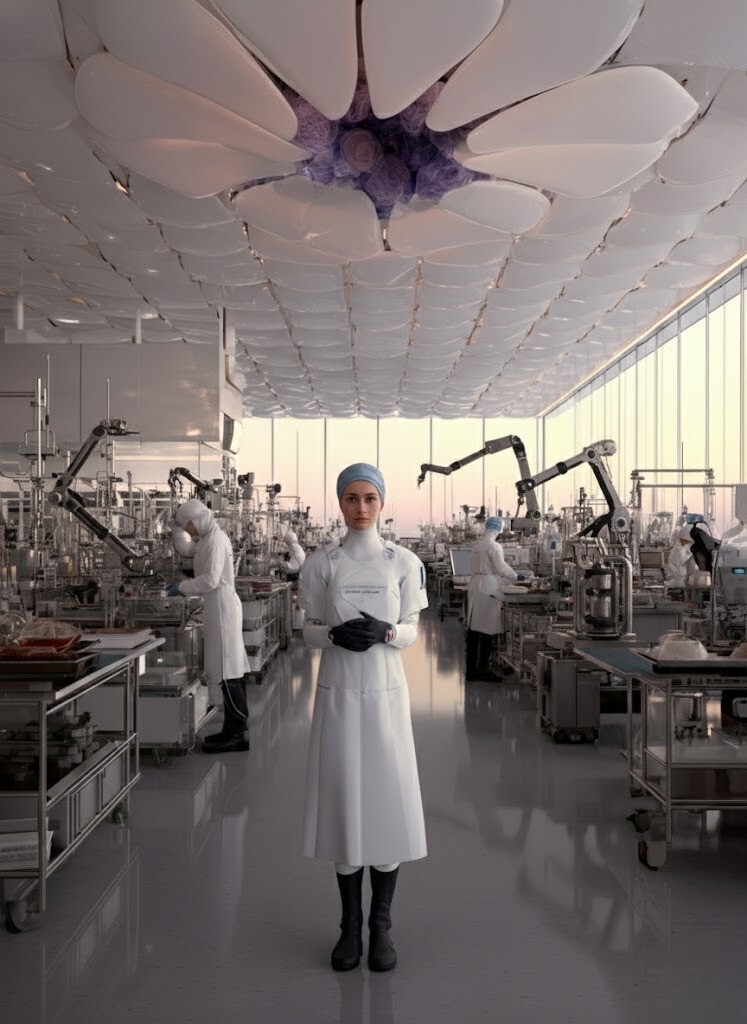
Medicine 2060: A View from the Future
What if medicine didn’t wait for illness? A future where cancer is manageable, organs are printed, and AI protects your health every day.
Medicine 2060 is a system that sees the problem before you feel it. And solves it before it becomes an illness.
How my day works from a health perspective
In the morning, I don't take tests. I don't make an appointment with a doctor. I don't wait for results.
My body is monitored continuously. An implant under my skin — the size of a grain of rice — tracks:
Inflammation levels
Hormonal balance
Early cancer markers
Glucose, oxygen, heart rate
Sleep quality and neuroactivity
The data goes to my digital twin. It's a mathematical model of my body. AI analyzes the changes and compares them to billions of patterns from other people.
If something deviates, I get a notification. Not “see your doctor in a month.” But: "Correction recommended in 4 days. The plan is ready. Please confirm."
Doctors still exist
Yes. But their role has changed.
Our doctors are strategists. Navigators. People who make the final decision in difficult cases. They work with the patient's values. With ethics. With things that an algorithm cannot take into account.
Routine diagnostics are performed by AI. It reads images, ECGs, tests, and genomes. Its accuracy is higher than that of humans. Its speed is instantaneous.
A live doctor gets involved when a choice is needed. When there is uncertainty. When the patient needs a person, not an interface.
Cancer
In 2026, cancer is a fear. A diagnosis that changes lives.
For us, it is a manageable condition. Like diabetes was in the past, only simpler.
What has changed:
Early diagnosis using micro-markers in the blood. The tumor is visible at the micro-stage — before symptoms, before metastasis.
Personalized mRNA vaccines. For a specific tumor in a specific person.
Immunotherapy and targeted drugs tailored to the genetic profile.
Nanobots for targeted drug delivery.
Survival rates for most forms of cancer are around 95-99%. Aggressive forms that used to kill within months are now becoming chronic conditions.
Cancer is no longer a death sentence. It is a problem that has a solution.
Organs
In 2026, people wait years for donor kidneys. They die while waiting in line.
We don't have queues.
Organs are printed. From the patient's own cells. On bioprinters.
The process:
Collection of the patient's cells
Reprogramming into stem cells
Printing the organ on a biocompatible scaffold
Maturation in a bioreactor
Transplantation
No rejection — the organ is genetically yours. Service life — the same as your own.
Liver, kidneys, cartilage, joints, skin grafts — all routine. Work on the heart and lungs is nearing completion. The brain — not yet. But partial neuroprostheses are already working.
Genetics
In 2026, the genome is decoded for a few. For us — for the majority of the population.
This changes everything.
Medicines are selected according to genotype. Not “one pill for all,” but a precise formula for a specific person.
Dosages are calculated according to individual response to the drug. Side effects are minimal.
Hereditary diseases are corrected. CRISPR and its descendants allow mutations to be corrected before birth or in early childhood.
Cystic fibrosis, sickle cell anemia, hemophilia — these words are known only to medical historians.
Neurointerfaces
In 2026, Neuralink is an experiment. For us, it is a medical standard.
Brain implants treat:
Severe depression
PTSD
Some forms of dementia
Paralysis
Paralyzed people walk. Blind people see through neuroprostheses. Memory in early dementia is maintained through stimulation.
This is not science fiction. It is clinical practice.
Aging
We have not defeated death. But we have changed our attitude toward old age.
Our average life expectancy is about 100-110 years. But what is more important is that these are years of active life. Without disability. Without degradation.
What works:
Drugs that slow down biological aging
Cleansing the body of senescent cells
Telomere support
Control of systemic inflammation
Cognitive training and neurostimulation
A 90-year-old person lives roughly as a 60-year-old did in 2026. They work. They think. They move.
There is no radical immortality. But the quality of aging is fundamentally different.
Mental health
In 2026, this is a “side issue.” For us, it is part of the medical picture.
Depression, anxiety, and sleep disorders are monitored in the same way as blood pressure and glucose. AI tracks patterns of speech, behavior, and sleep. It sees deviations before a person realizes there is a problem.
Combined therapy:
Pharmacology (personalized)
Neurostimulation
Cognitive-behavioral programs
Social connections are part of the treatment protocol.
Mental health is no longer a stigma. It is part of the norm.
Telemedicine
In 2026, people go to the clinic. They sit in line. They wait for the doctor.
We have 80% of consultations online. The doctor connects to the patient's digital twin. They see all the data in real time. They make a decision.
The clinic is only for procedures. Examinations that cannot be done at home. Operations. Physical therapy.
Everything else is done remotely. Quickly. Accurately.
What I see in 2026
You are on the threshold.
The technologies I have described already exist. In laboratories. In clinical trials. In startups.
CRISPR works. Bioprinters print tissue. AI diagnoses more accurately than doctors. Neurointerfaces are implanted.
All that remains is to scale up. Integrate. Make it accessible.
34 years is a long time. And it's not long. It depends on how you work.
The main difference
Medicine in 2026 is reactive. It waits for the disease to develop and then treats it.
Medicine in my time is predictive. It sees disease before it appears. And prevents it.
This is not just a technological shift. It is a different philosophy.
Health is not the absence of disease. Health is a system that supports a person every day. Automatically. Continuously.
Reading Time
10 min read